Breakout star of 2004
Actress and singer Lindsay Lohan, 18, is shown on the cover of the current issue of "Entertainment Weekly" magazine in this undated publicity photograph. Lohan was named as one of the breakout stars of 2004 by the magazine
Actress and singer Lindsay Lohan, 18, is shown in this undated publicity photograph, which is featured on the cover of her debut CD "Speak," which was released December 7, 2004
Showing posts with label entertainment. Show all posts
Showing posts with label entertainment. Show all posts
Dec 23, 2007
Breakout star of 2004


The Vibe Awards
Model and show host Tyra Banks poses on the red carpet before the taping of the Vibe Awards in Santa Monica, California November 15, 2004. The awards are presented to the outstanding performers in urban music
Musicians The Game (L) and 50 Cent perform during the taping of the Vibe Awards in Santa Monica, California November 15, 2004. The awards are presented to outstanding performers in urban music.


Kelly Chan to ring in the new year
Hong Kong actress and singer Kelly Chan is putting the final touches on preparations for her Coliseum Concert, scheduled to take place in Hong Kong this Christmas Eve


Fashion show in Lima
A model displays an outfit by Italian designer Vittorio Missoni at a fashion show in Lima, December 15, 2004. Missoni, famous for its exuberantly colored couture knits in bold stripes and zig zags, presented his fashion show retrospective in Lima to mark its 50th anniversary last year


Chinese actress poses at the Venice film festival
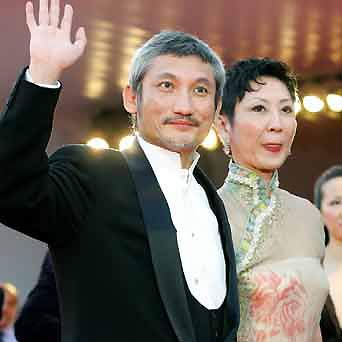
Chinese director Tsui Hark and his wife arrive at the Cinema Palace in Venice August 31, 2005. Hark is at the Venice film festival to present his latest movie 'Seven swords'.
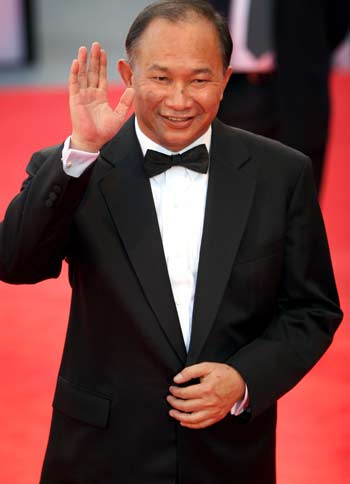
Chinese director John Woo arrives at the Cinema Palace in Venice for the premiere of Chinese director Tsui Hark's movie "Seven Swords" August 31, 2005.
Paris Hilton hacker gets 11 months in jail
A Massachusetts teenager who reportedly hacked into Paris Hilton's cell phone account has been sentenced to 11 months in a juvenile facility. Celebrity phone numbers stored in Hilton's cell phone were posted online when her account was hacked earlier this year.
A Washington Post report on Wednesday identified Hilton as a victim of the 17-year-old Massachusetts boy. The boy is a juvenile under federal law. Prosecutors would not name him or confirm Hilton as a victim, citing federal law that keeps such information under seal in juvenile cases.
The teenager was sentenced last week in U.S. District Court in Boston. He pleaded guilty before Judge Rya W. Zobel to nine counts of juvenile delinquency, prosecutors said.
The charges included hacking into Internet and telephone service providers, theft of personal information and posting it on the Web, and making bomb threats to high schools in Florida and Massachusetts, all over a 15-month period. While in custody and during two years of supervised release, the teenager is prohibited from possessing or using any computer, cell phone or other equipment capable of accessing the Internet.
Prosecutors said the teenager's first crime was committed in March 2004, when he e-mailed a bomb threat to a Florida school. The school was closed for two days while officials investigated and ruled the threat a hoax. In January, the teenager hacked into T-Mobile's computer system and looked up account information of its customers, including Hilton.
This spring, he arranged "with one or more associates" to make a bomb threat to a Massachusetts school, prosecutors said. They said an investigation of the teen's associates is continuing.
Hilton, a hotel chain heiress whose sex tape with an ex-boyfriend became a cyberspace novelty, stars on Fox's "The Simple Life." The story was first reported on the Post's Web site Tuesday. It said a washingtonpost.com reporter had a series of telephone and online communications between March and June with the teen, and that he admitted to the crimes for which he was sentenced. It did not publish his name.

Jackie Chan picks Gao Yuanyuan for new film
Backed by Jackie Chan's JCE Movies, "Project BB" secretly started shooting in Hong Kong. Mainland leading actress Gao Yuanyuan began work on the film a week ago, The Beijing News reported.
"Project BB" reportedly continues Chan's kung fu comedies, with three robbers who kidnap a baby. Familiar faces from Chan's "Project A," including Yuen Biao and Sammo Hung, are on board with the baby.
"Project BB" is directed by Benny Chen with screenplay by Yuen Kam-lun. Chan's previous project, "New Police Story," was a big box-office success on the mainland.
Gao met Chan at this year's Cannes Film Festival, where her movie "Shanghai Dreams" was in competition. Chan has characterized Gao as a fresh, chaste spirit no Hong Kong actress could approach, according to a source close to the situation.
Chan, Gao and her agent connected in Hong Kong in October at the celebration of the centennial of the Chinese film industry. And now she's on the set with "Project BB."
New medical reforms focus on grassroots medication
The long-awaited new round of medical reform has finally come to light. Nov. 12, an expert at the General Office of the Ministry of Health discloses that a national medical reform will be launched at the beginning of next year.
The basic medical system is supposed to cover 90% of all Chinese people and to bear at least half their medical expenses. Five principles for this reform have been set up, including giving priority to rural areas and to urgent issues. Our reporter has recently interviewed Tang Jun, secretary general of the Social Policy Research Center of the Chinese Academy of Social Sciences.
Marketization cannot be promoted at the cost of state-owned assets
Reporter: Can I regard the information the Ministry of Health released on Nov. 12 as the core of this round of medical reform?
Tang Jun: You can. However, some issues are still open to further discussion. For instance, what should be done to ensure that this reform will cover 90% of the masses. According to one source, by 2010, farmers around the country will be covered by a new rural medical cooperative system. However, a specific plan for this coverage has yet to be established.
Reporter: According to the disclosed information, what do you think is the biggest difference between the last medical reform and the upcoming one?
Tang Jun: The five principles for the upcoming reform show that this reform is in line with a people-centered philosophy, and puts aside marketization and industrialization. This is a signal of great progress. In addition, this reform attaches great importance to basic medical treatment and medical services in communities.
Reporter: Why is the upcoming reform aimed only at 90% of the population instead of 100%?
Tang Jun: This is just being prudent. I personally believe that it is practical to promote "all-people" medical services and to allow every person to enjoy basic medical services. In order to achieve these goals, we may use and build on our past experience. During the first 30 years since the founding of New China, 99% of the urban population has been based on work units, for which clinics and even hospitals were available. It is convenient for this population to have access to doctors. Above these clinics and work units-oriented hospitals, there were community hospitals and even larger hospitals. Everyone could afford medical services despite the lack of medical resources in this period. The work units-based administrative system has since crashed. However, we can still transfer the successful medical service models to communities so as to set up a network of infrastructure for medical services in China. In order to achieve this goal, the following issues must be dealt with. First, the operations model for doctors and their business should change. For instance, if doctors still provide sit-in medical services at clinics or hospitals, it will be a meaningless practice. Community doctors are bound by responsibility to do more than merely treat illnesses. They should help community residents establish health records, give checkups and provide family-care services as necessary. In other words, they should work more like the barefoot doctors of the past. Normal hospitals, which are at a higher level than community hospitals, should focus on serious illnesses and difficult-to-treat illnesses. There should be interaction between community hospitals and normal hospitals so that when a community hospital cannot adequately take care of patient, the patient can turn to normal hospitals.
Given the state of the upcoming reform, medical care costs will be sharply cut and medical services will be more available to the ordinary person. Most patients suffer from normal illnesses, such as colds. It is unnecessary for these patients to go to large hospitals. And patients who suffer from chronic illnesses, such as hypertension and diabetes, would not have to line up and wait at large hospitals. Therefore, it would be feasible to provide community-based all-people medical services. These services will be much cheaper than the current medical services based on medical insurance policies. According to one calculation, on the average, each person covered by medical insurance policies has to pay RMB1,000 a year. This is too heavy a burden for many people to bear.
The government should be entirely responsible for the health of average person.
Reporter: Those that are wealthy hope to receive better services. It seems that with the upcoming medical reform, this will not be met.
Tang Jun: In addition to government-run hospitals, there are some private hospitals, which provide high comfort, hotel-like medical services, on the condition that state-owned assets are not used for these private hospitals. Each person has the right to receive services provided by state-owned hospitals. Also, an individual is permitted to invest in any kind of private hospitals. The governments are bound by duty to supervise and regulate private hospitals, which are permitted to charge patients based on the market. Therefore, I believe three levels of medical service providers are necessary in China. The focus lies in the grassroots ones anyway.
Reporter: What topics have sparked the hottest debate?
Tang Jun: The hottest dispute lies in the need to marketize and industrialize medical services. According to economists, the prevailing medical service reform is not successful because it was not a full-fledged reform. They believe that an excellent marketization of medical services is still possible under certain conditions. I believe that the field of medical services is a very special field because of the requirements in special know-how. It is quite traditional to haggle over market prices when it comes to buying things. The preferences of consumers help bring prices into a reasonable range. However, it is impossible for patients to bargain with doctors. When a doctor advises a patient to undergo an operation, the patient cannot refuse. It is impossible to see market mechanisms playing a role in the field of medicine.
According to well-known psychologist A. H. Maslow people's needs fall into five levels. People's needs at the first level are biological needs, which include health and eating. The government must step forward and help ordinary people when they have difficulty in meeting these needs. Therefore, being entirely responsible for the health of ordinary people is the most fundamental duty of the government. I always say that the Ministry of Health is duty bound to stand in the corner of ordinary people and manage hospitals on behalf of ordinary people. However, this ministry took the side of hospitals and has acted as "general president" of all hospitals. This ministry created benefits for hospitals but not for ordinary people. If you go to a grassroots work units and talk with officials of local public health bureaus, these officials always naturally say, "The hospital is my son." Therefore, many problems cannot be solved until this ministry takes the "correct" side. However, these five principles still do not give a clear indication of the attitude of public health administrations.
The upcoming medical reform calls for terminating the monopolistic position of hospitals.
Reporter: According to the five principles for the upcoming medical reform, this reform emphasizes "priority to guarantee construction of grassroots medical institutions in rural areas." What do you think should be done in order to create an infrastructure network for effective medical services?
Tang Jun: We have been firm in promoting a three-level medial service system. However, if you head to rural areas, you will notice that central hospitals at the town levels are like chicken ribs, which are tasteless but will be a waste of money (meat) if thrown away. This is because transportation to cities is now convenient. If a farmer is ill, this farmer will first try to seek treatment at the local clinic. Should this solution not be adequate, the farmer will go directly to a large hospital in the city. Therefore, hospitals at the township and town levels have limited business. I feel it is necessary to locate these hospitals to lower levels. If the government insists on keeping first-level hospitals, hospitals at the township and town levels, these hospitals should be located in accordance with convenient transportation routes or conditions. In addition, doctors working at these first-level hospitals should function and work more like barefoot doctors in the past. The strength of this model is that doctors in village clinics do not earn salaries from the government but from the medical services provided to farmers. Doctors working in the first-level hospitals are paid by the national government. If these doctors go to rural areas, it will substantially cut the burden of farmers. I believe it is necessary to encourage these doctors to relocate to remote rural areas. The more remote areas they go to, the more money they can make.
Reporter: What is the largest obstacle for the upcoming medical reform? Funding or professionals?
Tang Jun: Neither of the two. The largest obstacle would be the benefits of some social groups. Some pharmaceutical companies, hospitals and government officials have a very strong influence on the entire medical system. These work units and officials have a monopoly on this system. If this monopoly is removed, all remaining problems will be solved.
Perhaps Love' pockets 18m yuan at box office
The first Chinese musical in four decades, "Perhaps Love" has received 18 million Yuan in box office earnings since it opened in cinemas across China on the 1st of December.
The number makes a new record for domestic cinema of the romance genre in recent years.
Shanghai cinemas top the box office, boasting 2.7 million in ticket sales during the first weekend.
The film has drawn all ages of audiences and enjoyed wide recognition both from audiences and film critics.
The love triangle's international cast stars Hong Kong singer Jacky Cheung, South Korean actor Ji Jin-hee, Taiwanese-Japanese actor Takeshi Kaneshiro and Chinese actress Zhou Xun
Miss World contestants in swimsuits
Swimsuit contest winners Miss Russia (C), Miss Moldova (R) and Miss Mexico pose for photos at the 55th Miss World Contest in Sanya, south China's sub-tropical island province of Hainan December 6, 2005. The finals of the pageant will be held on December 10
Miss World contestants parade in swimsuits in Sanya, Hainan December 6, 2005.Miss Russia, Miss Moldova and Miss Mexico won the swimsuit contest. The finals of the 55th Miss World Contest will be held on December 10
Miss World contestants parade in swimsuits in Sanya, Hainan December 6, 2005.Miss Russia, Miss Moldova and Miss Mexico won the swimsuit contest. The finals of the 55th Miss World Contest will be held on December 10
Miss Norway parades in swimsuits at the 55th Miss World Contest in Sanya, Hainan Province December 6, 2005
Miss Indonesia parades in swimsuits at the 55th Miss World Contest in Sanya, Hainan Province December 6, 2005
Miss China parades in swimsuits at the 55th Miss World Contest in Sanya, Hainan Province December 6, 2005






Chinese comedian Gao dies from heart attack
Gao Xiumin, a comedian known for her funny skits, died from a sudden heart attack at her home in Changchun, Northeast China's Jilin Province on August 18, 2005. Gao was popular with Chinese audience for skits played with Zhao Benshan, another big-name comedian in China. She died at 46.
Gao Xiumin (R) performs with Zhao Benshan (C) in the famous skit "Mai Guai" in a variety show on the eve of the Chinese Lunar New Year in 2001. Gao, a comedian known for her funny skits, died from a sudden heart attack at her home in Changchun, Northeast China's Jilin Province on August 18, 2005.
Relatives weep at the news of Gao Xiumin's death on August 18, 2005.



Subscribe to:
Posts (Atom)